Showing posts with label Race Report. Show all posts

Tuesday, April 29, 2014

A Week to Remember: Boston and a Little Cool-down Run

At some point or another, we've all likely succumbed to the bizarre phenomenon where time simultaneously flies and drags by . . . a week ago, I was running the Boston Marathon.  I know that because the calendar tells me so, but it could have been a month, or even a year ago as far as my perception goes.  Or was it yesterday?

BOSTON 2014 RECAP: Running as Another's Eyes and Ears

Boston 2014 will go down as a running event like any other.  Not only did the world's oldest continuous marathon see its 118th iteration, but a city, a state, a country, and large swaths of the world bound together to avenge the catastrophic events of 2013.  It was impossible not to be moved by the stories of resilience, of facing down terror, or overcoming incomprehensible adversity to take back an event which now unarguably transcends running.

#BostonStrong pretty much sums it up, but the meaning of "Boston" part of that has taken on an ever more broad definition.

For my part, not having qualified for 2014, I was determined to be a part of it, especially if I could do so by helping someone else realize his or her own goals.  Through a series of fortunate coincidences, I found myself assigned to guide a visually impaired runner, Corvin Bazgan from the Bay Area in California.

There is little reason to subject the few decent people who find themselves ensconced in the contents of this blog to a long narrative race report, especially since Boston 2014 wasn't about me.  Perhaps a list of highlights and other memorable aspects would be the better approach, then.

  • Corvin's original goal was to improve from 3:45 last December to 3:26 in one training cycle, in his third marathon and first Boston.  We revised that goal to 3:40.  It was a warm day, and the Boston course is notoriously unforgiving, especially to first-timers.  Alas, we ran a 4:25.  I enjoyed every second; I suspect that Corvin - at least at the time - did not.:-)
  • Doing this magnanimous thing led me to get to hobnob with one of the only celebrities over whom I would ever fawn . . . one of the other sighted guides was none other than NPR's "Wait, Wait . . . Don't Tell Me!" host Peter Sagal [or, as one Facebook friend called him, "Peter F-in' Sagal!"].  I got to have brunch with him; hang out for a few hours pre-race with him; run the first 7 miles of the race with his runner, Erich Manser, and him; and decompress after the race with him.  His in-person persona resembles his radio one, and it was very enjoyable to exchange barbs and banter with a pro. 
  • I also met Aaron Scheidies, whose visual-impairment didn't stop him from running a 2:44 (!!!) at Boston 2013 (and a 2:47 this year).  Talk about another inspiring story.
  • The energy in and around the city of Boston and the marathon route defies verbal description.  It made me feel warm and safe and energized and happy and loved and accepted and all sorts of other things.  It's unlikely I'll ever get to be a part of something quite like that again, and I'm extraordinarily grateful that I was.
  • I was the recipient of myriad acts of kindness, including having another runner, Dan Streetman, volunteer to clear a path ahead of my runner and me, as well as navigate the aid stations, every big-city marathon's most challenging feature.  It is unfathomable to me to have gotten through the race without that extra help.
  • I had wished many of my runner friends good races and "pleasant surprises".  My own pleasant surprise was that my friend Holly fell in with my runner and me at just before the halfway point.  Her sore foot was our good fortune, and she stayed with us until the finish.  That allowed Dan to surge ahead to find another visually-impaired runner who had outrun (!) her guide and was fumbling her way on her own.  Holly's grace helped two blind runners and one guide.
  • Seeing friends from all over before, during and after the race was a nonstop source of joy.  Some of these "virtual" friends have turned into some of my actual closest real-life friends.  Seeing so many of them on Saturday night and then again on Monday was a tremendous bonus.  I even got to have a nice quiet lunch with Mark Remy, without even having had to enter a Runner's World contest or anything. :-)
The weekend came and went too quickly, but I have a priceless film reel playing in my head, and have felt buoyed in all facets of my life by the high level of all things good during the Boston weekend.

On Tuesday, I went to the office, and eventually got home feeling pretty wiped out.  Wednesday was an intense work day, before the kids and I took off to Vermont for a couple of days of their school vacation.  I ran some during the week, got back home Friday night, packed up more gear and left for the next running-related adventure . . . a 50-mile race around Lake Waramaug in Connecticut.


Lake Waramaug Race Report: aka, "Oh Shit, My Balls!"

Monday, Boston.  Tuesday-Saturday, frantic bustle of a busy life. Sunday, a 50-mile race in order to qualify to run 100-mile race.

On Tuesday, I walked a couple of miles.  On Wednesday, I worked feverishly, so I could not make time to run as I'd hoped.  On Thursday, I slogged through four-plus S-L-O-W miles, starting up dirt roads/XC ski trails towards Mount Mansfield near Smugglers' Notch, then turning into a stiff headwind and finally ending on the roads amidst unwelcome snow flurries.  On Friday, I managed a lovely 10+-miler, into Jeffersonville, Vermont and back.  Saturday saw a 5+-miler in a cold rain before driving down to Connecticut to meet my equally crazy friend Tom and his wife for dinner before finding our B&B.

Saturday proved to be a cold rainy day, with a small wondrous window of mild sunshine just in time for our early dinner in West Hartford.  We even sat outside.  After a few sweet cheats post-Boston, I mostly kept to my low-carb/Paleo/NSNG way of eating, and felt good energy-wise.

Meredith and I vegged out to "Ghostbusters", which I hadn't seen in who-knows-how-long, and got to sleep reasonably early.

The B&B was nice, with other runners lodging there, as it was about 20 minutes from the race start.  Innkeeper Bill was super-hospitable, even making me eggs upon special request.  He was confounded by a distance runner not carb-loading before a race.  I spared him the inevitably sanctimonious-sounding explanations.

Pre-race breakfast consisted of COFFEE, two hard-boiled eggs, some salami, provolone cheese and a couple of peanut butter "Barista Balls" from my favorite local coffee shop.  These are delicious shots of fat and protein, which taste sinful but help me start many a day on a positive note, carrying me through to lunch with no hunger pangs or energy dips.

Meredith drove me to the race, where we got settled [she'd obtained permission from the RD to do an unsupported long run during the race], and I kept my sweats on in the chilly morning temps.  It was hard to tell what the day would do weather-wise, but the forecast called for mid-50s, sunny with 10+-mph winds. Visually, the lake looked stunning in the early morning light.

My good friend Nate met us there, and Tom rolled in at around the same time.

I wore my official Boston 2014 participant shirt, so that it might explain why I was running so slow.  Given the general badassery of the ultrarunning crowd, though, doing a mere marathon in the same week as a 50-miler is not really anything special.  I spoke with runners who had just done or were about to do 100-milers, and for whom the 50K or 50-miler was just an easy training run.  I also sported thin gloves and a visor, since hats no longer stay on my froed head when I run.

The course started with a 2.2-mile out-and-back section, leaving a total of 6 loops around the 7.6-mile lake perimeter to get an even 50 miles.  All I knew is that I needed to finish the race in less than 12 hours, and that I wanted to be done in under 10 hours.  I was mentally prepared for a long day, and was patient in the early going.

Nate took off ahead, intent on breaking 7 hours for the 50 miles.  He would end up deciding to drop down to the 50K distance, and finished second overall with a smoking 3:54.

I decided not to look at my running pace at this race, focusing instead on heart-rate as a measure of sustainable effort.  While the early pace seemed "fast", my heart rate stayed at or under 140 bpm.  That seemed just right.

Tom and I were jovially talkative in the early stages.  We engaged with other runners.  We joked when we crossed the "finish" line for the first of 6 times.  We smiled for the cameras.  We ran together, except for bathroom breaks (since portapotties are a bit tight for two).  Everything was going well, though the temps did not rise, but the wind did pick up.  The sun made occasional brief cameo appearances.  For the first time in a race, I actually added a layer.

Undertaking to finish my first 50-miler [I'd dropped out of the JFK 50 in 2012 [sorta injured but really grossly under-prepared], I wanted to have a solid fueling strategy.  Based in part on the phenomenal recent racing success of Zach Bitter, I decided to stay low-carb during the first half of the race, and then eat whatever appealed to me during the second half.  I took only water for about 10 miles, then had one Chia Warrior Coconut bar, which I take on runs of 3+ hours these days.  I also had some of those delicious Barista Balls, though my cold-compromised fingers dropped two of them as I finished the second full lap.  That's when I said, to no one in particular, "Oh shit, my balls!", as I saw that delicious pair roll downhill towards the lake.  In an ultramarathon, it's a good idea to bring extra everything, and I was glad to have more balls in reserve. ;-)  Turns out, I would need them.

Somewhere around Mile 20, the reality of the moment hit me.  I had committed to running 50 miles today, just 6 days after the Boston Marathon.  This race was on pavement.  Things started to hurt: calves, quads, hips, shoulders/neck.  But, I shook off the negativity and just stayed in the moment: this lap, the next aid station, the next mile.

After completing the third lap, we were at about the 27-mile mark, more than half-way done and past the marathon distance.  And, for me, the Festival of Unrestricted Fueling was about to begin.  And that was my basic mindset for the rest of the day: Run to the next aid station. Eat and walk.  Start running again.  Repeat.

A sampling of what I did end up eating/drinking in the second half of the race:
  • Chicken noodle soup
  • Grilled cheese sandwiches
  • Deviled eggs (am-A-zing!)
  • PB&J
  • Fritos
  • Smartfood
  • Potato Chips
  • Pretzels
  • Peanut M&Ms
  • Oreos
  • Graham crackers
  • Candy fruit slices
My stomach felt fine all day.  My mental energy was ample and positive, much to my beloved fiancee Meredith's surprise.  The fourth time around the lake was the toughest.  Then the fifth lap was worse.  I had no doubt I was going to finish, and I started playing some math games.  Tom did the same, and we ended up running within view of each other, but no longer together.  Without saying a word about it, we understood that it had to be this way.

Coming into the Start/Finish for the final time, I saw Meredith and Nate.  My spirits were still good, but my body was tired.  I'd passed my all-time mileage PR (40 miles when I turned 40) and was in completely uncharted territory.  I felt some new aches, and had a blister which felt compelled to remind on every other step that running 50 miles on pavement is kind of a stupid endeavor.

The last time around the lake was a bit of a slog, but Tom and I treated it as our chance to say goodbye to the wonderful aid station volunteers, including the flirty ladies at the second station; the self-styled aid station chef (auteur of the morning's breakfast burritos, bacon, soup and grilled cheese), the soft-spoken blue-Gatorade peddler at the third station and then the home stretch.

Without a doubt, the least pleasant section of the course was a 2-mile stretch along Route 45, which was much busier than the rest of the lakefront road, and took us straight into headwinds which gusted upwards of 30 mph.  The final turn back onto North Shore Road was a blessing.  Tom and I cruised through the last aid station, where I had some coke and water, and then we headed for the finish.


My Garmin was reading long, so I expected to finish closer to 50.4 miles, as measured by my watch.  Tom was struggling (as was I) and he asked me if we had about 1.5 miles to go.  I didn't mean to be brusque, but I sort of snapped my response: "Don't worry about it."  He said something else, but I didn't really hear it, because a switch suddenly flipped and I picked up the pace.  Before I knew it, I had sped up by over 3 minutes per mile, dropping down into the low-7:00-minute range.  I had no idea that that could ever happen after running for 9 hours.  As I pumped my arms and breathed fast-but-steadily, I came upon a woman ahead, another 50-miler who'd been ahead of me for most of the day.  I flew by her less than 100 yards from the finish, and she was clearly a bit befuddled (as was I).

I raised my arms, hooted and hollered and literally took a flying leap under the finish banner [nearly crashing into the aid station table when I landed].  Official time: 9:07:56.  9th male finisher; 12th overall.  Tom came in a moment later, having been sort of blindsided by my unexpected kick.  I hugged Meredith, and Nate, and Tom, and would have hugged anyone else who'd have let me.

50 MILES DONE IN UNDER 12 HOURS.  VERMONT 100 QUALIFICATIONS ALL SATISFIED.  RACE PLAN EXECUTED.  EXPECTATIONS EXCEEDED.

As I said up top . . . it was a memorable week.

Thanks for reading. -Ron

Thursday, November 7, 2013

THE (RUN-)WALKING DEAD: NYCM 2013 "Event" Report

After two October trips to the pop-up Halloween store, it appears that the zombie apocalypse is nigh.  It used to be that female-targeted Halloween costumes tended to the "Sexy/Naughty/Slutty".  While that remains true, now it seems that "Sexy/Naughty/Slutty Zombie ___________" is the order of the day.  The title of this post, therefore, comes from the fact that this blog - moribund for so long - simply refuses to die.  It may also reflect my guiding experience in last weekend's New York City Marathon.

A LITTLE CONTEXT

Every marathon race is a 26.2-mile journey (YES! that's the official marathon distance, dammit) that begins long before the runner toes the starting line.  In this case, my journey began in the late summer of 2012, when I was lucky enough to be chosen by Achilles International to guide a triple-amputee Marine who would be doing his first marathon in a handcycle.  Alas, Superstorm Sandy nixed that.  Then came Boston, where I was assigned to run with an above-the-knee amputee (we'll call him TS) who was shooting for a 4:30 finish.  As with so many of life's endeavors, things did not go as planned for TS there.  He set out a bit too fast in the first half, but the second-half fade spared us from being much, much closer to the finish line at the time of the bombings.  We made it to Mile 25.5, and immediately made a pact to try again in NYC in November.

So, for me, NYCM 2013 started more than a year earlier.  For TS, this would be a race almost seven months in the making.

THE RACE

If finishing time is the only measure of marathoning success, then NYCM 2013 would have to be filed as an unqualified disaster.  Fortunately, though, it isn't, so it wasn't.  And because the metrics are not conventional, neither should a "race report" be.  Rejoice, therefore, Dear Reader, since this post will not take you through a mile-by-mile recap of the good, the bad, and the ugly which tends to comprise the marathon race experience.  In fact, this wasn't really a race at all, so I won't treat it as such.  Instead, I would characterize more like a series of wonderful and discrete experiences tied together by consistent forward motion towards a blue and orange banner in one of the world's most famous parks.

Knowing that his training had not been optimal, and dealing with a problem in his knee (as in, his only knee), TS dialed back his original 4:15 goal.  As I pressed him, he cagily said "4:30-4:45".  Having run and paced and guided quite a few of these things by now, I prepared myself for a mostly pleasant five-plus-hour amble through the Five Boroughs which are New York City.  It was a good thing that I did, because it turned out to be all of that and more.

What follows here, though, is a list of the encounters, images, and memories with which I left New York City.  Maybe every significant life experience changes in some way.  Serving as a guide for NYCM 2013 certainly changed me as a runner; time will tell how much it has changed me as a person.

THE START

View from the AWD starting area
The ride from Midtown Manhattan was dark and long, though the sun was up by the time we got there.  TS and I rode together, and I mostly just sat quietly, preparing myself for the long day ahead.  The Achilles bus was full of Athletes With Disabilities (aka, AWDs) and their Guides.  All of the athletes on our bus were ambulatory, as the wheelchair/handcyclists require special transportation.  AWDs span a wide range in terms of the conditions which lead to their needing a Guide.  Amputation, blindness, paralysis, and cerebral palsy were among the reasons I heard from fellow Guides and their runners.  We were shuttled to a special AWD staging area, and the most striking visual was the scores of wheelchairs and other adapted contraptions which would allow so many people to pursue their dream of hurtling 26.2 miles through the five famed boroughs of New York City.


SECURITY

Having been on the course during Boston 2013, and having pored over every announcement about heightened security at NYCM, I was prepared for anything.  TS was checked quickly and allowed to bypass the metal detector/body scanner, since his composite carbon-fiber prosthetic leg would have set off the machine.  I was extended no such courtesy, and therefore waited, and waited, and waited while a malfunctioning metal detector was resuscitated by NYPD officers.  Not surprisingly, the police department was out in force, but I noticed many officers with special badges, including "Auxillary", "School Safety Division", "Taxi Squad", and others.  Everyone was on call.  And virtually every one of them was attentive and courteous.

From the time we arrived at the start area until I made it back to my friends' Upper West Side apartment some 8+ hours later, I saw more uniformed police than I had ever seen in a single day in my life.  Other shows of high-alert included police buses, armored vehicles and strategically hovering helicopters.  I was able to take the following picture from the Verrazano-Narrows Bridge:


The ubiquity of armed personnel watching over 50,000 runners and more than a million spectators was simultaneously comforting and unnerving.  After Boston, authorities weren't going to take any chances.  Since the 2013 NYCM went off without an incident, their abundant caution worked.  Still, perhaps some day such measures won't be necessary to thwart prospective wrongdoers, or even to assuage public concern about bad things happening.  For now, though, reality dictates differently.

BROOKLYN

Staten Island gets the race start, and - as in life - apparently not much else.  On the Verrazano-Narrows Bridge we climbed the first big "hill" amidst a cold, strong crosswind as we headed towards Brooklyn.  The eerie quiet of the first few miles soon gave way to people, lots and lots of people.  People yelling.  People dancing.  People playing musical instruments.  People holding signs.  People clapping.  People encouraging every single person who went by in the most unequivocally positive terms.  It's not something one sees every day, and certainly not in a city of over 8.3 MILLION (!) which would not be named a bastion of congeniality on a normal day.  The New York City Marathon makes for not a normal day.

Brooklyn was a blast. 

Because TS lost his left leg above the knee, he has to run as far to the left of a course as he can, which is the safest thing both for him and for other runners (in fact, my job as his guide is to create a buffer zone between him and the field).  That means that we always stayed close to the spectators on the left side of the road.  And so, in Brooklyn, began the high-fives.  Little and medium-sized kids were the most eager to get a hand-slap from a passing runner.  I tried to get every single one (often yelling as I passed, "MAKE SURE TO WASH YOUR HANDS!"), and then, to my surprise, nearby adults would extend their hands, too, offered with a sincere word of praise.  Not just the parents, either.  Adults cheering alone.  People in traditional garb from other countries.  Old people.  Religious people (well, not the Hasidic Jews in Williamsburg).  Even some of NYC's finest extended a hand along the way.

Brooklyn included people of virtually every conceivable nationality and skin tone.  To think that they all convened just to see us (us!) was a happy realization indeed.  I heard my name yelled by a guy I know from online running circles, the only time that would happen over the course of the race.

AWD IN DISTRESS

During the first half of the race, I was pretty pumped up, so I checked and rechecked our pace to make sure I didn't lead TS out too fast.  Unfortunately, that I didn't didn't matter.  It wasn't his day to chase a new marathon PR, but he stayed laser-focused on that finish line.

After settling into a decent groove, putting us on pace for a 4:45-ish finish, TS started slowing down.  Runners often describe that feeling as the moment in a race where "the wheels come off".  Well, not long after we started experiencing that, we came upon an AWD who was the literal embodiment of the phrase.  At almost exactly the Mile 14 marker, TS and I say an Achilles AWD in a prone handcycle off to the side of the course.  The athlete seemed dazed and confused.  He also did not speak much English.  Turns out he's Italian, which felt like karma since I have been shirking my self-guided Italian study and was thus able to say only, "Io non capisco l'italiano" ("I don't understand Italian").  The right rear wheel on chair was cracked.  It had been temporarily held together with duct tape, but as he sought to move the hand pedals, the wheel just came off the axle.  He seemed like he might be hurt, so we called on available race medical volunteers until they thought they had found one who spoke Italian.  10-15 minutes after we came upon the poor prone fellow, we were moving again.

I have tried to find out what happened to him, but no one seems to know.

QUEENS

Dealing with the athlete in distress was our welcome to Queens, so perhaps in an effort to get back into "race mode" (or, at least, "finish mode"), I was less aware of my surroundings in Queens.  It's also just a few miles.  Still, I remember more high-fives; more clever signs ("SMILE IF YOU PEED A LITTLE"; I smiled, even though I hadn't ... yet), and more wild cheers.


Then came the Queensboro Bridge, where we had another AWD encounter.  This time, it was a stopped Achilles amputee, whose prosthesis had become unsafely loose.  We needed a specific hexagonal key to tighten it, but no one had one.  I tried "MacGyvering"it from detritus I found on the ground (a paper clip, a zipper pull, a piece of a key), but no luck.  So, I jumped the concrete barrier, ran up to an ambulance, and asked for help.  No dice.  We left that runner and his Guides behind, but saw him pass us a while later, which made us happy.

At this point, I felt a bit low.  The wind whipped across the Queensboro Bridge; the sky was still gray.  It had gotten crowded on the course, which presented more challenges in terms of keeping TS safe.  We still had over 10 miles to go, and we were walking.  A lot.

It's not very often that I have the impulse to punch a 70-something year-old (much less a runner) in the face, but at about Mile 15.5, we experienced the one act of nastiness amidst a day of otherwise unfettered kindness.  As an elderly gentlemen passed us during a stretch of walking on the bridge, he literally yelled that we were "taking up half the path".  As he kept moving, I replied, "Sorry [sarcastically] . . . we have a disabled runner here."  Most people would apologize, or otherwise acknowledge their overreaction, but he instead doubled-down: "I don't give a shit!  You should be in a single file."  When we caught him less than a half-mile later, I might have eased over to the left again just a tad closer than what one might call socially acceptable.  My job is to keep my runner safe.  Other runners, beware: I take my job seriously.

MANHATTAN, THEN THE BRONX

Manhattan brought what Manhattan is known for bringing: crowds.  People lined up 10 or more deep.  Lots of well-dressed folks sipped coffee.  A few of those who leaned their Starbucks cups over the railing were surprised when I pantomimed helping myself to their tasty hot beverage.  Reactions ranged from pulling away, to laughing, to offering their cup with the greatest sincerity.  We may have been moving slowly, but I was having fun.

The East Side blocks ticked off.  Somewhere, maybe around 100th Street, I started hearing a loud female voice roaring, "JESUS!  JEE-SUS!!! JEEEEEEEEESSSSSSSSUUUUUUSSSSSS!!!!!"  Turned out to be an older black woman, waving a black leather-bound bible.  "JESUS!!!!!!!!"  We walked.  "JEEEEEEEEEEEEEEEEEEEE-SSSSSSSSSSUUUUUSSSSSSSSSSSS!!!"  We jogged a little.  And, finally, we reached her.  Looking more through me than at me, she let it rip, the bible shaking in her hand: "JEEEEEEESSSSSUSSSSSS!!!!!"  I looked at hear, smiled, and said, "No, thank you."  Some runners around me smiled.  TS yelled something about foregiveness.  We forged ahead.  She kept screaming.

A few blocks north of the Church Lady, another exuberant spectator was putting on a cheering spectacle of her own.  On the right side of First Avenue I noticed a younger black woman, slim, with bleached blond hair.  She was sprinting up and down the side of the course, pointing at runners and screaming, "This is YOU runnin' fast," over and over and over.  It was also her, but it's not clear if she appreciated the irony.

And then, seemingly in a flash, we reached the Willis Avenue Bridge, for our brief foray into The Bronx.  As we neared the end of our first pass through Manhattan a guy yelled, "You're almost in the The Bronx!"  I jokingly asked him, "Is it safe?"  His response: "You won't be there long."  I felt so much better.

The Bronx really was just a blip.  A little over a mile and then we were on our final bridge, the Madison Avenue Bridge, for our return to Manhattan and the final push towards the finish.

MANHATTAN,REDUX

The gray skies finally cleared, the temperature rose a few degrees, and we were in the home stretch.  More walking.  More high fives.  More cheers and signs and massive good will.  We were moving slowly, but no one seemed to hold it against us.

I had a nice moment with an older lady in Harlem.  She was in a wheelchair/scooter, sort of slumped, with a sign which read "Harlem HEARTS You".  I looked straight at her and smiled, and she sat up straight, beaming a huge smile back at me.  A perfect little moment like I've never had before, and likely will never have again.

Somewhere after the Mile 22 mark, Central Park came into view.  What a sight, though we were still walking and we still had 4 more miles.  At Mile 24, we turned into the Park, still walking more than running.
 It didn't matter anymore, because the time on the clock meant nothing to us.  The only thing that mattered was that a man who'd lost his leg in a car accident about 8 years ago and a big-eared, Jewfro sporting goofball who likes to cover long distances on foot in the company of others were inching ever closer to the Finish Line denied them in April thanks to a couple of terrorists with a horrifically misguided sense of purpose.  For TS, this would be another finish line in a sport he took up before he became "disabled".  We were cold.  We were tired.  We were ready to be done.  But, I think I speak for TS when I say that we also felt like yelling, "Fuck car accidents!" and "Fuck terrorists!" and "Fuck anyone and anything which seeks to get in the way of people and their hopes, their dreams, their spirit!"  We were going to finish, and finish we did, 202 days, 5 hours and 34 minutes after we first started running together in Hopkinton, Massachusetts.  Not fast by most measures, but at least ahead of Pamela Anderson. :-)


Monday, May 20, 2013

Laying It Out There

Running.

It's been a huge part of my life since I started on July 4, 2006.  It's been my friend.  It's helped me make friends.  It's been my nemesis.  It's been an addiction.  A lifeline. Therapy. Burden. Opportunity. Buttresser of self-confidence.  Inducer of self-doubt.

Running played a supporting role in the breakup of my marriage.  It is also how I met my current love.

Running has remained by my side all this time, but it has been a complicated relationship.  At some point, after running a marathon PR in April 2011, I lost my zest for training.  I didn't want to get up early to run.  I didn't want to run every day.  I didn't want to run hard.  I sure as hell didn't want to race, at least not without pre-fabricated excuses ("my first 50-miler", or "I'm doing 4 long races in 4 weeks") and solid reasons for why my fitness and performance had fallen so far so quickly ("These damned hip flexors!").

But, I didn't want to shed my identity as "a runner".  As "the running lawyer".  As that crazy guy who runs all those miles, eats & drinks to his heart's content, and always stays trim and toned.

Except that I was living a lie, or at least an illusion.

I've not gone more than a few days without running in the past few years, but I've run less often.  And shorter.  And more slowly.  And, most sadly, I've lost much of the joy and satisfaction which comes from being competitive with oneself, with pushing one's perceived limits and finding new ways of improving, achieving, excelling.

Well, the time has come to reconnect with running, or move on to something else.  So, I tried a running streak (and hit 70 days).  That helped a little.  I guided at Boston.  That was an extremely memorable experience.  I scheduled another Boston qualifying attempt, at Keybank Vermont City on May 26th, and was following Pete Pfitzinger's 16-week, 70-mile-per-week plan. That went okay, until I fell off the bouldering wall and sprained my ankle.

But a key unknown in all of this has been the question that's tougher to ask than to answer: "Just exactly how much fitness have I lost?"  There's only one reliable source to answer that, and it displays its responses in hours, minutes, and seconds.  So, I've been on a racing tear, with four races in 14 days.  Here's the verdict:
  • Flat 5K on May 4 - 20:25 (PR is 18:46); couldn't make my legs move faster than that
  • Half-marathon on May 11 - 1:38:55 (PR - 1:26:xx); chewed up and spit out by hills, humidity and wind
  • Slightly tougher 5K on May 16 - 20:3x, a personal worst on that course since I became 'a runner"
  • 12K (~7.5-mile) on May 18th - 52:44 (a HUGE PR, as I've never raced that distance before), and by far the best race in terms of
    making a realistic fitness assessment and executing intelligently . . . suddenly, racing seemed fun again
So, what's the takeaway from this?  I'm done with marathons.  At least for now.  I've withdrawn from Vermont City, and will instead head to Maine for my second annual Pineland Farms 50K.  I will probably not qualify for Boston 2014, so I won't get to go back as a racer and somehow seek to find some personal measure of validation for the fact that so much was taken away from so many on April 15, 2013.

What does this mean exactly?  Well . . . I'm not on a specific training plan.  I'm running every single day, though, even if only a few miles.  I'm joining friends at the track if I feel like it.  I'm racing when it's convenient and close to home.  I'm rock-climbing.  Lifting weights.  Playing soccer, and riding bikes, and playing tag and slacklining with my kids.  I call it loosening my grip.  Some might call it living.

Where will this lead?  I have no idea, but I do know that allowing one's hobby to become a major source of life stress is basically one big failure.

So, what's after Pineland Farms next weekend?  Other than probably a couple of easy miles the next day, I have no idea.  And I feel much happier about that than I could have imagined.

Tuesday, May 7, 2013

I Couldn't Have Said It Better . . .

than so many other articulate, thoughtful, wonderfully eloquent observers . . . .

Before the start at Athlete's Village . . . bubbling with joy and optimism.  Must we now redefine "it"?
So . . . I am not going to post my usual longish Boston 2013 "Race Report".  Suffice it to say that my amputee runner, co-guide and I were a safe distance away from the finish area at the time of the blasts, are all physically unharmed, and managed the chaos and confusion of the situation as well as anyone.

We got word out to our friends and family; we retrieved our material possessions.  Our inspiring amputee runner will receive a finisher's medal, despite having to stop at the 25.5-mile mark, because the course just turned into a fretful sea of humanity, with the police telling us what NOT to do, but not otherwise giving any clear instructions.

The whole experience has been on the edge of overwhelming.  There are some obvious reasons for that (I was there; I live an hour from Boston; runners/marathoners are my "community"; etc.), and some less obvious ones.

Innocence has become a precious commodity in our modern world.  Loss of any of that precious innocence compounds the very tragedy which takes our innocence.  A vicious cycle.

Every day I think about the Boston Marathon.  About how things could have been different for me.  How they SHOULD have been different for the three people who were killed.  How April 15, 2013 has permanently and indelibly scarred the 200 victims, and so many more of us.  How the attack and subsequent police investigation brought out some of the very best qualities in all of us.  How sad it is that the inspiration towards selflessness, caring, charity and love abates all-too-quickly.  And about much, much more.

Yet, I'm going to stay away from much of that: theodicy; existential angst; political grandstanding; the seemingly insatiable need for contextualizing the inexplicable.  Oh, and the media.

Thank you, Boston Marathon, for everything you have given me, fellow participants, the "local" community, the running world, and the countless people who normally don't give a whit about running yet find themselves moved by an event that brings together 25,000+ people seeking to challenge themselves, motivate others, help charities and otherwise simply choose to live in a way that honors the gift which is our limited time on this planet.

One more thing: Boston has also led me to rethink my relationship with running, including (especially?) the marathon distance.  More on that to follow in the days ahead.


Monday, July 23, 2012

On Paces, Races and Beautiful Places

“We can never have enough of nature. We must be refreshed by the sight of inexhaustible vigor, vast and titanic features, [ ] the wilderness with its living and its decaying trees, the thunder-cloud, and the rain.”
- Henry David Thoreau

Dolly Sods Wilderness - July 6th through July 8th

Since returning from California and the Western States Endurance Run less than four weeks ago, I've have the good fortune to spend more time in spectacularly beautiful places - blissfully large doses - while in the company of the highest-caliber people - in small and medium-sized doses.

After the Independence Day holiday, I accompanied Meredith into the Dolly Sods Wilderness, for my first multi-night backpacking adventure in as long as I can remember.  The purpose and timing of the trip had profound significance, and I got to see a wonderfully unspoiled and remote part of the East Coast.  Just reaching Dolly Sods was a journey in itself, while hiking its spectacular trails was a unique experience, as the area boasts varied ecosystems, flora and fauna, mesmerizing rock formations, expansive views and dense forest, not to mention a bounty of sweet, ripe wild blueberries at this time of year.  A few photographs which don't really begin to do justice to Dolly Sods are available here.

While the trip presented myriad challenges (physical and otherwise), it was a gift to get away from cars, computers, phones and - mostly - other people.  And, as with so many trying experiences, confronting the difficulties and getting through them has resulted in a welcome Nietzchean adaptation, as I feel stronger (about a number of things), than I have in a long time.  I hope to go back to Dolly Sods someday, and navigate the terrain more gracefully than I managed this time, . . . assuming I'm invited to do so.

Training & Nutrition

So far, working with a coach and following his prescribed training plan has gone pretty well.  I have permitted poor planning and sloppy scheduling to get in the way of full compliance with the plan, but the consistency and overall arc of training is much-improved over what I've experienced in the past year.  The most notable fail on my part was missing a scheduled 20-miler on July 15th (and aborting a re-try on July 16th), but it feels like I've been doing enough long, slow, time-on-my feet runs/hikes that missing a single long run shouldn't make a huge difference.  My weekly mileage is starting to creep up into the 60s, and I very much look forward to settling into higher mileage once again.  Getting a break from one of the more relentless heat waves of my adult life should also have a positive impact on training.

That said, the most exciting development in the health and wellness sphere has been that a change in diet has produced dramatic positive changes in my GI system.  Having met a former pro triathlete who's a certified Nutritional Consultant, I looked into what he promotes in terms of how endurance athletes should eat.  The result was a long questionnaire - and even longer personalized analysis - of my "metabolic type", which dictates not only what foods I should and shouldn't eat, but also provides for specific food pairings and macro-nutrient ratios.  I began this new regimen two weeks ago today, and have likely been somewhere around 75% faithful to the plan (zero beer simply ain't gonna happen).  The results have been so dramatically positive so quickly that I have not only had better runs overall, but have also experienced improved sleep quality, better mental alertness and lesser dependence on caffeine.  My energy levels have been consistent, and I've been notably more productive at home and at the office.  There's no "one-size-fits-all" nutritional approach, which is a key component of the Metabolic Type plan.  Anyone who's had fueling/GI issues might want to consider looking into it.  If you're so inclined, send me a comment and I'll put you in touch with my guru.

The Vermont 100 - 2012 Pacing Report

On Friday, July 20, 2012, I set off for my third consecutive year of helping out at the Vermont 100 mile race.  As this blog has contemplated in the past, my "purpose" in the running world seems to be more about serving others as a pacer than about achieving much by way of personal glory and accomplishment when racing in my own right.
The predictably spectacular summer sunset over Silver Meadow in Brownsville, VT
So, I agreed to pace my new friend Kelly this year, as she sought to improve upon her formidable 2010 time of 20 hours and 50 minutes.  My schedule leading up to race weekend was extremely hectic, with unexpected travel and work complications resulting in little downtime and not much sleep.  Still, as soon as I got close to the race HQ at Silver Meadow on Friday evening, a sense of serenity, belonging and happiness came over me.

It was great to see my close friend Nate as he revved up for his first 100-miler of the year, and to find John, Andy, Joe W., Chip, Laura, Pete, Brett and Joe H., just to name a few of the familiar friendly faces which took part in this year's race.  Kelly seemed good on Friday night, and - after being admonished for being too loud in the campground at the advanced hour of 8:45 pm - it was time to turn in for the night.

For me, Saturday brought a questionably achievable itinerary, as follows:
  • 3:45 am - wake up to catch the start before going back to sleep
  • 5:40 am - wake up again to set out to volunteer at the Pretty House aid station
  • 9:00 am - leave Woodstock, VT for Greenfield, NH to see my two younger kids get out of sleepaway camp; in proud New England tradition, it was a case of "you cahn't get the-ah, from hee-ah"
  • 1:30 pm - back to Silver Meadow
  • 2:00 pm - get to Camp 10 Bear (aka, Mile 70) and wait for Kelly
  • 4:30-5:00-ish pm - expect Kelly and settle in for 30 lovely miles in the woods and on country roads
Things went mostly according to plan, though I missed Kelly and Nate at the Pretty House aid station, which left me to wonder if they were okay.  After a brief cot nap amidst the cacophony of 10 Bear, I arose and got ready to run.  I met Kelly's excellent crew of Gene and Gene (son & father).  Kelly rolled in at about 5:15, looking pretty strong for someone with 70 miles behind her already.

We headed out of 10 Bear, only to confront one of the toughest segments of the course.  Kelly ran what she could and we power-hiked the rest.  Once we reached rolling dirt roads and single-track downhills, Kelly got down to business.  She was moving well, with no significant ill-effects from her earlier spill, blisters or the shear wear-&-tear of this massive undertaking.  We got in and out of Seabrook and The Spirit of 76 (a.k.a., West Winds, at Mile 77) smoothly, with the Genes providing fantastic, efficient support.  Kelly drank, ate and otherwise seemed to be holding up admirably.  The sun was setting, and the conditions were lovely as the temperature dropped.

Things took a turn at around Mile 80, though, when the course cruelly brings the runners within mere yards of Silver Meadow, with an all-too-appealing view of the campgrounds, and the cozy sanctity of sleeping pads and bags just waiting for someone to use them.  Kelly got a bit cranky at this point, and we agreed that she needed food (STAT!).  She moved well enough as we approached the Cow Shed aid station, but she just couldn't take in anywhere near enough calories.  Kelly's stomach simply wouldn't settle down, and it was tough to watch helplessly as the wind leeched from her sails. After an unsuccessful bathroom break, we made Bill's Ban into the goal.  There, we'd see the Genes, and Kelly would eat, ditch her hydration backpack and - hopefully - get a second (or sixteenth) wind.

It was, however, not to be.

Kelly arrived in the throes of abject exhaustion, still unable to get any substantial food into her system.  The medical volunteers flagged her immediately, and Gene the Younger and I quietly debated whether to push Kelly to get back out on the course.  Kelly complained about feeling hot, but her skin was cool to the touch.  The volunteers explained that this was a common sign of exhaustion.  In the end, reality became undeceiveable, even though Kelly might have been able to walk the last ~12 miles in 5 or so hours. That was not what she had come to do on this particular day.  So, while Kelly battled nausea and acute fatigue (she was literally falling asleep in a chair), and the clock hit 10:00 pm, the head medical volunteer (a very, very nice doctor) "made the call".  Kelly had to accept the dreaded DNF (Did Not Finish) and we promptly evacuated her back to the safety and comfort of her tent.  She'd run almost 89 miles, but these events are not evaluated on a grading scale.  They are pass/fail, with a single criterion determining whether the day was a good one, or not.

Upon getting Kelly into her tent, I grabbed my cooler full of tasty beer and a folding chair and headed to the finish area.  It was just past 11:00 pm, and I decided to wait for Nate to finish.  I found Charlie Z., a wonderful 60-something with whom I'd had a completely delightful time chatting last year.  Turns out that he paced Victoria Arnstein to the overall female victory in the 100K race.  Victoria is the wife of 2011 VT-100 winner Michael Arnstein, who put in a mere mortal performance this year (finishing a bit under 19 hours), just a couple of days after finishing the torturous Badwater Ultramarathon (135 miles in Death Valley).  An accomplished ultrarunner by the name of Dave James (who paced winner Brian Rusiecki to within 50 secnds of a course record) also joined us, and - despite the unabashed display of elite athlete ego and bravado (I heard A LOT about big victories, course records, national titles and how some other runners are poseurs), along with the Arnsteins bantery marital bickering - it was an entertaining way to pass the time as finishers came in.  It was especially amusing to tease Michael about how it was a good thing that Victoria performed well, lest the Arnstein family leave Vermont without a victory this year.  He didn't seem to find that as funny as the rest of us did.

Finally, as the race clock approached 22 hours, I saw Joe H. come in with his pacer.  I congratulated him and asked about Nate.  Joe told me that he'd dropped at Mile 70 due to a lingering PF/ankle issue.  That was all I needed to hear to empower me to call it a day, and I got to sleep at around 2:30 am, wondering about those intrepid souls who would be making their way through the dark for many more hours.  I slept pretty well.

The awards and lunch on Sunday were a tad chaotic, and Kelly was beleaguered by post-DNF remorse.  I tried to console her by pointing out that if she HAD walked to a 23-hour finish, she'd be similarly disappointed in herself.  And, so - on a gorgeous sunny summer Sunday - it came time to break camp and wrap up another Vermont 100.  On the heels of Western States, though, my mind wandered into previously unexplored territory: I actually started thinking about how I'd approach running the Vermont 100 in 2013 . . . . Meredith called the idea "stupid".  The fact that she's undoubtedly right is not impacting my decision.

-ESG/Ron

Wednesday, July 18, 2012

A Little Bit (or A Lot) of Most Everything - Pacer/Crew Report Westerns States 2012

For the middling amateur athlete such as yours truly, being a part of a world-class sporting event usually requires buying a ticket and watching while others do the "heavy lifting".  In the case of the Western States Endurance Run, though, the only ticket I had to buy was a plane ticket, and the "seats" I'd reserved would involve being part of Kami Semick's crew and then pacing her for the final 20 miles of what is arguably the most prestigious race in ultrarunning, a race where last year Kami finished second to Ellie Greenwood, thanks in part to a grumpy grizzly bear blocking Kami's way in the final miles.

After a long day of traveling - loaded with beer and gear, marred by travel, traffic and construction delay - my friends Jay (who was celebrating his birthday) and Holly and I finally made it to Squaw Valley late Thursday night.  We went out for a drink with Jay's runner, Ryan, and finally turned in at about 1:00 am (aka, 4:00 am EDT).

Friday would bring seeing and meeting more friends, as well as the complimentary Montrail 6K Uphill Challenge and Fun Run, taking participants up the steep climb out of Squaw Valley along the first few miles of the WS trail.  It was humbling to "race" at altitude, so I ran/hiked it, and then added some mileage, topping out somewhere around 9000 feet.  It was exhaustingly exhilarating to cover nearly 10 miles at that elevation, but it was a worthwhile experience.

[AT THIS POINT, I'VE LEFT THIS POST UNATTENDED FOR TOO LONG; THEREFORE, WHAT FOLLOWS IS STREAM-OF-CONSCIOUSNESS HIGHLIGHTS]
  • Kami is one of the nicest, most-down-to-earth people I've met, though her gentle nature does not mask a burning intensity to compete at the highest levels of a very demanding sport
  • Co-ed sleeping arrangements involving leaky air mattresses are not that fun, a sure sign that I'm pretty far along in metamorphosing into a cranky old man
  • I have some friends who are amazing runners, some who are talented drinkers, and at least one who is both
  • Asthma and cold rain are a rough combination, as Kami had to drop out at Mile 30 because of the niggling inconvenience of BEING UNABLE TO BREATHE.  She ended up in the hospital, but was discharged the same day
  • A 100-mile point-to-point course which traverses mountains and crosses rivers appears to be considerably longer than a 100-mile loop course
  • A great way to make and cement friendships at this more "advanced" stage of life is to crew an ultrarunner, or just hang out at a 100-mile race
  • I'm addicted to pacing, apparently, as I seemed to suffer withdrawal symptoms when it appeared that I would not have a runner.  I was so sure that I would not be pacing, that I started drinking a tasty Colorado brew hand-delivered by a friend.  I had about 10 minutes' notice to change out of street clothes and get ready to run.  I climbed, descended and crossed a very cold river.  I had a blast.
  • Ultrarunners are a little bit crazy; I like ultrarunners
  • Despite some notable negatives, California is a remarkable place in many ways
  • Lack of oxygen and sleep, coupled with supranormal alcohol consumption, leads to repeated and extended bouts of giddy silliness, punctuated by short periods of hungry, tired crankiness
  • 100 miles is a long way to run, but the 100-mile running community is small . . . and some people seem to have been around and around it
  • That a person is toting the distinctive WS winner's trophy should be a dead giveaway that that person won the race (oops!)
  • After having no interest in doing a 100-mile race myself (really, truly, sincerely), WS has made my mind wander; though, as I've said to some friends, "I just can't imagine sucking at something for so long, with the more I suck, the longer it'll take" [insert clever word play here]
Looking back, Western States 2012 was like a time-defying dream sequence, where I slept in a different place with a different combination of people for 5 nights in a row, and during which I encountered countless folks who were all drawn to the same place for the same reason.  I also got to bear distant witness to some remarkable athletic feats, as the Men's and Women's Course Records fell, and the Men's Masters' Record was also re-written.  In a world where many of us may doubt our inborn capacity for doing extreme and extraordinary things, 100-mile races show that with hard work, persistence and commitment, virtually anything is possigble . . . and that when we (as a species) reach a seemingly unassailable benchmark, it's just a matter of time before someone comes along to assail it. :-)

Happy running, or whatever it is that you do which challenges and motivates you.

-Ron/ESG

Tuesday, May 29, 2012

Back from The Waste Land


APRIL is the cruellest month, breeding   
Lilacs out of the dead land, mixing   
Memory and desire, stirring   
Dull roots with spring rain.

T.S. Eliot, "The Waste Land"

ON BOSTON 2012

As best as my very brief research shows, T.S. Eliot was not a runner.  Yet, if one trait of great literature is that it speaks in universal truths, the above-excerpted opening to Eliot's master work "The Waste Land" applies to those of us who look forward to April not because of rising temperatures and blooming lilacs, but for the opportunity to run 26.2 miles from Hopkinton to Boston.  For many of us, April can be simultaneously wonderful and cruel, sometimes on the same day, within mere minutes, on a well-worn route trod by countless distance runners over the last 116 years.

For me, the past year has been full of months (along with hours, days and weeks) both wonderful and cruel, as I have figured out how to make my way in the world since getting separated in February 2011.  Overall, things are quite good.  Work is going very well; the kids are thriving; and Tina and I are finding a way to be positive co-parents, and - quite possibly - friends.  That said, running has been a struggle, and thus blogging about running has seemed like a more frivolous and pointless pursuit than usual.

The training malaise which started some time in the summer of 2011 lasted all the way through Boston 2012.  Unlike during all my previous training cycles, I took unscheduled days off, bagged workouts, paid less attention to diet/nutrition, and essentially lost sight of how the consistency of daily action influences the achievement of long-term goals.

The historic high temperatures in Boston this year derailed many runners.  For me, though, it was a gift, as I now got a "free fun run" out of a race for which I was undertrained, and would thus have underperformed even in the best of conditions.  So, I set out with my friend James (a 2:55 marathoner coming back from an injury) and we jogged in the 90-degree heat, finishing with smiles on our sweaty faces in 3:53.  It was the slowest I've run since my first marathon (4:03 in Chicago 2007), but possibly the most fun I've had on a course, taking in the sights and sounds, high-fivin' the kids and turning around at Mile 25.5 (!) for an eternally memorable kiss from Meredith (yes, that friendship has blossomed into a whole lot more).

GETTING SERIOUS ABOUT RUNNING-RELATED FUN

With Boston "out of the way", I decided to pull myself out of the running funk by setting an ambitious running agenda for the remainder of 2012.  Here is the Master Plan:

PINELAND FARMS RACE REPORT

Pineland Farms would be my second official ultramarathon race.  It's known as a moderately hard course, with no giant climbs, but with an unrelenting rolling profile, along with the challenge of running through unevenly cambered/tufted mowed paths in farm fields.  This graphic may overstate things, but the dearth of flatness definitely comes through:

Pineland Farms Elevation Chart (25K loop)
Without putting too much scientific thought into goal-setting, I thought I could run the first of the two 25K loops in about 2:30, then hang on and do a slight negative split in order to sneak in under 5 hours.  As with so many of life's plans, the idea sounded quite good in my head.

We lined up at 8:00 a.m., with the day's 50-mile runners having had a two-hour head start, and the 25K runners waiting until 10:00 a.m. to begin their quest.  Given the mild morning temperature and net downhill of the early miles, I quickly settled into what felt like an easy pace, running well under 9-minute miles with little effort.  I drank, took gels and ate a Clif Mojo Bar as planned, along with taking an Endurolyte capsule every hour or so.  The humidity was pretty high, and I noticed that I was sweating . . . a lot.  Still, I figured I had nutrition and hydration under control, so I was not especially concerned.  Perhaps I should have been.

At about the 10-mile mark, the course brings runners around the start/finish area.  I ditched my disgustingly sweaty shirt, and pressed on for the last 5+ miles of the first loop.  I was moving well, and approached the mid-way point in about 2:18, well ahead of my arbitrarily projected pace.  I saw a race official and asked about the drop bags, which I thought would be in the start/finish area.  Turns out, I had run right by them at the Final Mile Aid Station about a mile earlier.  That was a regrettably dumb mistake on my part.  I should have researched EXACTLY where the drop bag (with my additional gels and food) would be.  With the potential consequences of that error in rattling around in my head, I also answered nature's call at the portapotties in the start/finish area.  Despite the slight setback, I was still feeling strong, steady and hopeful.

At the beginning of the second loop, the miles continued to tick off pretty quickly, and I started thinking about the possibility of a pleasantly surprising finish time.  No sooner did I start doing the "best-case-scenario math", though, than I started to struggle.  I lost energy.  I tried eating (mostly boiled potatoes with salt) and drinking (mostly Gatorade) more at and between the aid stations, but it was not helping.  I went from being tired, to being listless, to cramping up each time I forced myself to run.  I finally found my drop bag at about Mile 22, but at that point it was too late to fuel myself out of trouble.  A textbook embodiment of ultramarathoning inexperience.

After about Mile 24-25, I walked each uphill, the very same hills which had seemed quite slight on the first pass.  I tried to run the flats and downhills, but my left hamstring and right calf resoundingly vetoed that idea.  the race thus evolved into a proverbial distance running "death march", where the sole goal is to keep moving forward in order to complete the dastardly undertaking that seemed like a wonderful idea just a few moments earlier.  I bled time; I got passed; I passed some people (mostly slower 25K and 50-mile runners), and basically wrote off any specific time goal.

Of course, the Running Gods almost always have the last laugh, and as I rounded the final curve in the mowed field nearing the finish, I saw that I was not as far back from the 5-hour goal as my under-fueled, overtaxed brain had believed.  I gave it a final push, but it was for naught, since my official chip time was 5:00:58, good for 41st overall (out of about 200) and 14th in the ever-competitive Male 40-49 Age Group.

Not exactly smiling after 5+ hours of running.

Still, seeing a number of friends before during and after the race and just being part of such a wonderfully positive, life-affirming event was more than enough to soothe the sense of disappointment at not having executed a solid race.  My friend Nate broke 8 hours in the 50-miler, despite a pre-race hamstring strain and having a rough day out there.  My friend Kate won her age group in her very first ultramarathon, despite running with broken ribs.  Nate's brother Matt ran his first race ever, putting in a strong 25K.  I saw Chip and Scott and Joe and second Joe.  I brought my own good beer to share once the Smuttynose ran out.  It's truly a blessing to belong to the ultrarunning family, a close-knit group of pretty eccentric folks who constantly prop each other up.  If only more other realms of life could mirror this sort of communal kinship, the world would be a better place.

WHAT NOW?

Now it's time for me to return running to a place of honor in my life, to remember the physical, mental, psychological and emotional benefits it provides, and to remain mindful of the way in which it can benefit others, both directly and indirectly.  Indirectly is through the apparent motivation and admiration others find in my recreational pursuits.  Directly is in the form of getting back to the fundraising-for-a-cause aspect of this whole lifestyle which helps break of the all-too-common box of self-absorption.  In the fall, I will seek to raise money for Achilles International and/or the Christopher and Dana Reeve Foundation, combining the two marathons and 50-miler into a "we-can-all-do-more-than-we-think-we-can" pitch for people to support these two very worthy causes.

I'll make no grandiose promises about blogging (or not blogging, depending on one's perspective), but I will be more intentional about running, training, eating and racing from now until the end of the year, when further major life changes may take place.

Thanks for reading.  Happy running to you and yours.

-ESG/Ron

Monday, May 16, 2011

Muddering Through It: Tough Mudder/New England Race Report

On Saturday, May 7th, I had a new racing experience. As I should know by now, signing up for events months and months in advance can make such events seem like abstractions, like intriguing ideas that will never ripen into actual physical activities of the most challenging and uncomfortable order. Tough Mudder falls squarely into the "it-seemed-like-a-good-idea-at-the-time" category.

For the uninitiated, Tough Mudder grew out of a Harvard Business school class project, which the professor found interesting, but critiqued the fact that the organizers would likely never be able to attract enough participants (about 500) to break even, much less turn a profit. Tough Mudder events now exist all over the country, and sell out regularly, with well over 10,000 people doing events on any given weekend. The idea behind Tough Mudder is to create a ridiculously challenging, but nonetheless surmountable, course, ostensibly under the auspices of "former British Special Forces". The races involve - of course - mud, along with challenging terrain, icy water hazards, and all manner of obstacles requiring one to go up, over, through or around, with a lot of effort.

For my part, bounding up and down a mud- and snow-covered mountain did not intimidate me. Climbing, balancing, jumping . . . no problem. Electrical shock?  Bring it.  But being immersed in near-freezing muddy water time and again required me to confront one of my own demons. Ever since my body started to adapt to high running mileage by getting leaner, I've had almost zero tolerance for cold water.  Turns out, that's a significant part of the Tough Mudder experience, especially in Vermont in early May.  So, while my relationship to cold water might not be a phobia, per se, it definitely qualifies as a strong aversion, and thus became the "thing" upon which I fixated as the Tough Mudder start approached.

I got up early and made the longer-than-expected drive to Mount Snow.  It was a mostly gray, cool morning, with the car thermometer reading between 38 and 46 degrees.  It was blustery, but didn't look like it would rain.  As one friend put it, one good thing about Tough Mudder is that the weather is basically irrelevant.   True enough.

I arrived early enough to park, take a few pictures and get into the "zone".  I strolled around, appreciating the clever-but-contrived signage.  I got my face and arm "marked" with my race number.  I saw all sorts of folks: military-types, runners, triathletes, costumed wing nuts, tall, short, fit-looking, not-so-fit-looking, well-geared, and minimally-dressed.  Hairstyles were colorful and interesting, with the dyed Mohawk perhaps the most favored look.  Many teams had matching uniforms, some more fanciful than others.


Seeking to stay warm, I lingered inside, then got into my racing clothes before checking my bag and making the 1/3-mile hike up to the starting area.  I was one of the first participants to line up, and we were the day's first wave of "Mudders".  I chatted with a few folks at the start, including a young Army guy who'd just run a 1:18 half-marathon off minimal training (hate him!) and a guy who operates an adventure race blog featuring Tough Mudder reviews.  I talked to two guys who are striving to do ALL Tough Mudder races around the country, including twice in one weekend sometimes.

The pre-race speech was a tad too canned for my taste.  The announcer read a prepared script, whipping us into a frenzy, and fomenting an atmosphere of this event being an expression of rogue courage which would somehow elevate us to a higher state of being.  He brandished a large poster of Osama Bin Laden, with a large red "X" through the photo, and some of the crowd started yelling, "USA, USA, USA!!!"  I found the demonstration somewhat distasteful, and while I appreciate that Tough Mudder raises money for the Wounded Warrior Project, the Bin Laden gesture seemed cheap, disrespectful and completely contrived.  We were there for our own sakes, to play in man-made obstacles with only minimal danger to ourselves.  This was semi-extreme recreation, not the sort of goal-based sacrifice that would make the world a better place (and analogizing that premise to our current international conflicts is a loaded exercises in itself).

And, so, after months of anticipation, the gun sounded and the masses dashed down the steep base of Mount Snow, some yelling like medieval warriors, before turning left and heading STRAIGHT UP the steep ski slopes for a mile and a half.

I was trying to find a rhythm, and it soon became clear to me that trying to run up a 30+% grade with alternating surfaces of slippery mud, grass, wet rock, snow and ice was to embark on a fool's errand.  Add to that the charming touch of being sprayed with snowmaking machines (meaning, thick mists of cold water), and I changed my slogging jogging gait to a power hike, letting a number of fellow Mudders go ahead of me.

After what seemed like an eternity, we finally stopped climbing and started to confront the obstacles which supposedly set Tough Mudder apart from other endurance events and adventure races.

In all honesty, I cannot remember the particular order of the challenges/obstacles, but I certainly remember many of them, particularly those involving exposure to frigid water.  Here are some highlights:
  • Devil's Beard - After missing this obstacle because a wooded lateral trail section was poorly marked, several us had to run back UP the mountain before slithering under taut cargo nets across rugged mountain terrain.  I'd imagine that this is where the scraping of my body began in earnest
  • Boa Constrictor - Possibly the least appealing obstacle, involving two long tunnels which each dipped down into frigid muddy water, leaving barely enough room for one to turn one's head and keep breathing.  This was my first immersion, and I emerged from this obstacle with numb hands and feet, and with blood dripping down my knee and shin
  • Tires - basically running up through a series of tired, with an occasional mud pit making it interesting
  • "Ball Shrinker" - this water crossing involved a suspended tightrope which plunges the intrepid participant into chest-high water.  I asked the safety kayaker near me if he'd be kind enough to return my testicles to me if he saw them (though, we all know to where they retreated in an effort to survive)
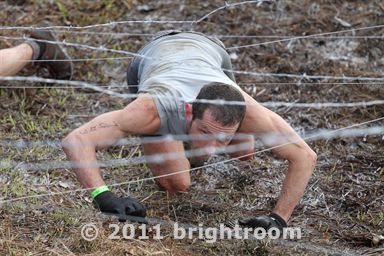
  • "Kiss of Mud" - crawling under barbed wire wasn't nearly as bad as I'd feared

  • "Hold Your Wood" - physically, this may have been the most challenging undertaking, as we had to grab a ~40-pound log and carry it up and then down an extremely steep pitch.  The footing was treacherous, and I had to "learn" how to fall safely, so that the log wouldn't land on me or roll down and take out any fellow competitors.  I commented to a fellow sufferer that after the cold water festivities, that was the only "wood" any of us would be holding.  Tossing that log back into the wood pile was a major relief.
  • Evil Kenevil - This turned out to be an easy up-&-over.
  • Spider Web - climbing cargo nets proved very manageable, and gave weary legs some much-needed rest
  • "Walk the Plank" - The mother of all Mudder obstacles, at least for me.  This involved climbing a rope up to a 15-foot platform, then plunging into what was billed as 35-degree water.  This was my moment of confronting and conquering many a personal demon.  I did it, but the effect of that water was truly a shock to my system.  I pulled myself out of the pond, and told the volunteers that "You all suck", with a big smile on my face.  I felt like the worst HAD to be over by that point.

  • Underwater Tunnels - This obstacle merely involved plunging through a muddy pond, under several progressively lower horizontal posts.  Not fun, but short.

  • Funky Monkey - Greased monkey bars make for good times, as I got through about 4 rungs before falling into the - you guessed it! - muddy water below
  • Berlin Wall - The only challenge which required a group effort to surmount.  I hooked up with three other guys, and we figured out how to get each other up and over.  It was a great mental, physical and social exercise.
  • Glacier - This involved climbing up a large heap of snow, and then descending down the hard, cold, rough downside.  Here I managed to pass the only woman who'd been ahead of me in our wave.  I don't usually care much, but it was nice not to get "chicked" in this particular testosterone-heavy endeavor.

I was passing plenty of others in the final stages, and ended up in a sort of "head-to-head" battle with a guy I'd seen since the beginning.  On the poetically-named "Turd's Nest", I passed him and did not see him again until after the finish.

The final few obstacles involved trudging through iced red water in the "Blood Bath", sliding down the mountain on wet plastic, hurdling some uncomfortably handled metal pipes, and then the two Tough Mudder signature finishing obstacles: "Fire Walker" and "Electroshock Therapy".  The fire segment was mostly a noxious stretch of blinding smoke.  The much-ballyhooed electric shock was little more than the sort of ticklish pinprick one would get from a novelty hand buzzer.


I charged through finishing chute alone, arms pumping while a few people cheered, with the clock reading 11:19:xx am, meaning I'd just taken nearly 2 hours and 20 minutes to go 10 measly miles.  I also heard - informally - that I was 10th overall in the heat, which I guess was a good thing.

I got my finisher's headband and race t-shirt, some food, a space blanket and lingered around waiting for others to finish.  I grabbed a Dos Equis, drank about two sips and tossed the rest.  I watched as people threw kegs at cardboard cutouts of celebrities.  And then I de-briefed briefly with a couple of other finishers before heading towards the gear check in an effort to get dry and warm.  The line was very long, as the later starters were checking in, and only a couple of us were seeking to get bags we'd checked earlier.  There was some confusion, and I just stood there, shivering, while the volunteers looked for my belongings.  Several aspiring participants started asking me questions, commenting on my bloody legs, seeking reassurance that it wasn't "so bad".  One young woman asked, "How do you feel?" A: "Tired." Q: "But happy, and glad you did it, right?" A: [after long pause] "I'm tired."  She seemed deflated.

Looking back on Tough Mudder, the life-timing of this event was apropos as it turned out, given that it fell  at the end of a very intense and difficult couple of weeks.  I'd been in a bit of a post-Boston funk, running less than I have in years.  I've been tired, somewhat listless, and quite preoccupied with the transition I'm making from married father of three to separated part-time "single" dad.  Other personal confusion and challenges have also abounded.  But Tough Mudder was a great opportunity to do something "different", something outside my athletic comfort zone, and to do be pleasantly surprised by doing it pretty well.  As usual, the life lessons and parallels are there for the taking.

One common question since May 7th has been, "Would you do it again?"  The answer for me is that I'd consider doing it in a warmer place and perhaps with a team of similarly-conditioned folks, since the camaraderie of the experience is one of the things which sets Tough Mudder apart from the typical running race experience.

Thanks for reading. - ESG

Monday, May 2, 2011

"More (or Less?) Than a Feeling": Boston 2011 Race Report

A goal properly set is halfway reached.
--Abraham Lincoln

It's probably only a tad ironic that the marathon which has taken me the least amount of time to run has resulted in my taking the longest amount of time to generate a race report.  There are a couple of reasons for this, the main one being that - two weeks removed from it - I still don't know how I feel about my performance in the 2011 Boston Marathon.  And, so, without further qualifying equivocation, here's the report.

After the debacle which was Boston 2010 (and my running year as a whole), I had trained for and expected to run a certain time in 2011.  That time was not to be.  My sub-3:05 goal slipped away in the Newton Hills, but rather than an epic blowup, I managed to contain the slowdown and finish my second Boston Marathon with a new PR of 3:08:48.   It's difficult to characterize the result in terms of good or bad, satisfying or disappointing.  It's all of those things - and more - but the experiences from the race (and from the weekend as a whole) are more significant than the final time on the clock.

With so much going on in my life at the moment, it's difficult to know where to begin this year's race report, but it may serve everyone's interests in just focusing on the race itself.  Suffice it to say that the weekend involved some personal highs and lows, as I reconnected with some friends, forged new friendships and struggled through the complicated dynamics of marital separation.

PRE-RACE

After some crazy scrambling with my friend Steve/TTM on Sunday night, where we raided a number of southern New Hampshire chain stores in search of a tarp on which to rest at Athlete's Village on Monday morning, we finally found one in the automotive section of Wal-Mart.  I had not set foot in a Wal-Mart in about a decade, and Sunday night was a bit of a freak show there.  Still, we acquired 160 square feet of vinyl protection, and ended up back at my place a bit after 10:00 p.m., later than either of us had hoped.

We crashed at about 11:00 and I had the alarm set for 4:00 a.m., so that we could be on the road and under the Boston Common in time to get on the first wave of buses leaving Boston for Hopkinton.  The drive went smoothly, and we found James and Kevin with no problem.  My other friend Steve was also supposed to meet us, but he left his phone in his car and never did find us among the assembled throng.

The ride to Hopkinton was fine, and I was calm and relaxed.  I had not looked at pacing spreadsheets, brought no pace band with me, and otherwise was not thinking about tackling 26.2 miles in a certain time.  Instead, I was thinking only about saving some energy early and settling into a sustainable sub-7:00/mile pace.

We arrived at Athlete's Village and set up our monstrously large tarp.  Friends and strangers kept finding us, claiming small swatches of dryness as we all waited for 10:00 am to roll around.  Everyone was fueling up, drinking, standing in bathroom lines, etc.  Seth found me, and we hung out with his Swedish friends for a while.  The wind was blowing, but the frenzy over the unprecedented tailwind had everyone feeling at peace with the weather.  Sunday's storms had blown over, and the sun was shining from a brilliant blue sky.

Time passed in fits and spurts, with some segments seeming long; other moments passed by at warp speed.  We all started getting our gear on, applying BodyGlide, eating, drinking, shedding layers.  The whole scene definitely had the feel of a religious gathering, with shared rituals co-existing peacefully with individual habits.

The time finally came to meet up with some friends who'd come on a charter bus, check the gear bags and head to the starting corrals.  I had a twinge of regret about the incompleteness of my last bathroom stop, but it turned out to be too late to do anything about it.  I also forgot to put my calf compression sleeves on, which makes a second critical omission in two consecutive Bostons (forgetting my HR monitor last year).

I found my way into an overflowing Corral #8, said good-bye to one of my friends who was several corrals ahead, waited for a bit, shed my long-sleeved shirt and then pushily made my way towards the front of the corral.  The energy was palpable as thousands of highly-trained, tapered runners endured their final moments of energy restraint.

THE RACE

Miles 1-5

1 - 7:18
2 - 7:00
3 - 6:55
4 - 6:54
5 - 6:57

The Boston Marathon boasts 115 years of distance running lore, staged on the same course year after year after year.  For all the great moments and triumphs, it's a course which has surely chewed up and spit out more runners than probably any other road race in the world.  As a sort of recreational runner's "All-Star" race with a pronounced downhill start, Boston tantalizes many an aspiring PR-seeker to go out too fast before paying dearly for such over-exuberance.  I wanted to go out "easy" and take 3 or so miles to settle in.

Other than the annoyance of navigating the crowd, things seemed to start well.  I felt an uncomfortable pang in my stomach, which I attributed to nerves and did my best to ignore.  I found a tangent along the left side of the course, weaving more than I should have, but less than I wanted to.

By the end of Mile 2, I had found my groove, and was feeling good about the pace, my effort and what lay ahead.  I tried to draw energy from the fans without expending any extra by high-fiving or otherwise hamming it up.  I stayed alert to those around me, especially during the aid stations, but very much sought to remain in my own space.


Miles 6-10

6 - 6:54
7 - 6:49
8 - 6:49
9 - 6:52
10 - 7:21*
*includes Garmin distance adjustment

I paid attention to my stride and form, being careful not to over-run the downhills.  It seemed like I was doing fine, and my heart rate stayed relatively low throughout this segment.  Somewhere after Mile 5, I passed a guy in a bodysuit animal costume.  I pulled up next to him and said with a grin, "I hate when costumed runners are so fast."  When I saw his face and heard him speak, I realized that he was from Japan, and he replied, "Oh, thank you.  You have beautiful form."  I'm guessing he didn't quite grasp what I'd just said, but I gladly accepted the compliment, knowing that if it wasn't a lie at that moment, it was likely to be soon enough.

With my stomach still a bit of a question mark, I took my first gel at about Mile 7, a Gu Roctane pineapple (no caffeine), chased by two cups of water.  I'd drunk only water at aid stations to this point, and fueling-wise, I seemed okay.

In about Mile 9, I saw a runner towering over the rest of the field.  I ran next to him and told him that his ability to move at that pace was very impressive.  I guessed that he was 6'8" or 6'9", but he told me that he's actually 6'11", and that he's never seen anyone taller in a marathon.  He said that there's nothing special about him running, as he's just putting one foot in front of the other just like the rest of us (except with about half as many strides per mile).

Up until Mile 10, the pace felt right and encouraging, such that I had a sense that it could be a stellar day.  Yet, for no obvious reason, Mile 10 was very difficult.  I suddenly felt labored and tight, and thought that my day may be coming to a premature end.  Still, unlike in marathons past, I stayed with it, kept my wits about me, and regrouped.

Miles 11-15

11 - 6:58
12 - 6:57
13 - 6:55
14 - 6:54
15 - 7:11

This was a strange segment for me, as I didn't feel great, but remained encouraged by the mile-by-mile splits.

The Wellesley women were MUCH more boisterous than I remembered from 2010, and the "Wall of Sound" greeted us a good half-mile before the screaming co-eds came into view.  Unlike last year, though, I stayed in the middle of the road, glanced at some of the scream tunnel signs and soaked in the energy and atmosphere.  I felt privileged to be running the Boston Marathon, to be treated like someone special for a day.  I also resolved to make sure I stayed positive for the second half of the race, regardless of what ended up happening.

I crossed the half-marathon mark exactly where I had hoped to be, at 1:31:31.  I simultaneously felt hopeful and concerned.  For reasons that I can't completely explain, I had a sense of foreboding, but I tried to discount it as the irrational fear of a runner attaining a new fitness level.

Mile 14 marked my second gel, a Carboom raspberry.  My stomach was not calm, and the GI melodrama went into full swing, as my stomach and I transitioned from a state of a detente of benign discomfort to possible full-blown disagreement, but each time I thought about making a pit stop, there'd be no port-a-potty, and when I did see one, the urge would temporarily subside.  I finally decided that I would stop, but there was a line.  So, the decision essentially made itself.  I was going to roll the digestive dice and see how long I could hang on.

Miles 16-21

16 - 6:57
17 - 7:20
18 - 7:13
19 - 7:27
20 - 7:29
21 - 7:56

At this point, I knew the hills were coming, and I was not sure what to expect exactly.  I was prepared to slow down, but wanted to feel like I was maintaining a pretty even effort. I stayed as steady as I could, but I knew that I wasn't going to be pulling off any late-race heroics.  I ground my way up the hills, and somewhere around Mile 17 or so, I felt a hand on my butt.  It was a rather incongruous sensation at that point in a marathon, and I was not feeling particularly flattered or amused by the attention.  I turned to see my friend Seth behind me, not a good sign.  Our exchange went kind of like this:
Me: What are you doing?!
Seth: Jogging, dude. I'm done.
Me: [With a somewhat disgusted glare of disbelief] I can't talk to you now.
Seth: Cool.  Go for it.

I spent the next mile or two feeling badly about having been such a jerk to my friend, but as a runner I knew Seth would understand.  Given that his goal was even more ambitious than mine, I knew he was in a bad place, but I realized that I was, as well.  I was very much trying to keep myself in the race mentally, to accept that marathons are not - at least at my mediocre level - all-or-nothing endeavors.  I still had plenty of "room" for a PR, and I knew that I had a good chance to break 3:10.

So, I rode out the hills as best I could, and figured that - if nothing else - I would hang in longer than I did last year.  Progress by degrees, rather than by leaps and bounds, became my new reality.

And, with no particular degree of pomp or circumstance, I was up and over Heartbreak Hill, slowing down, but still running.

Miles 22-Finish

22 - 7:28
23 - 7:36
24 - 7:31
25 - 7:45
26 - 7:29
0.2+ - 1:37 (6:24 pace)
Most of the hoopla surrounding the Boston Marathon is about getting in, known to runners as "qualifying".  The training, the careful selection of qualifying races, the new need to rush to register.  It's all about getting to the party.  And, while I'll readily admit to having gone through all of that myself, I've spent more time thinking about the end of the race, particularly those last 5+ miles when one has earned the opportunity to run through the streets of Boston as someone special for a day.  Last year, my greatest regret was that I death-marched the last 5+ miles in a cramp-riddled, depressive slog.  I was more war victim than celebrant.


Before this year's race, I vowed to run the last 5 miles strong and with a smile on my face.  As I came down from Newton, though, I realized that "strong" was subject to situational redefinition.  The promise to sport a smile, on the other hand, lay entirely within my control.


No math whiz on a good day, it's ironic that the last miles of a marathon put me in human calculator mode.  I was trying to figure out what it would take to hang on and break 3:10.  I had the WILL to run faster.  I believe I had the CAPACITY to do so.  But, in the critical moment, I lacked the ability to turn my legs over any faster than I did.  I knew I was slowing down, but I refused to stop.  I knew my dreams of a major marathon breakthrough were on the side of a road somewhere in the last few miles.  I also realized that I was slowing down to what used to be my goal pace.  In other words, my "bad day" used to be my "good day".  That meant - and means - that I have reached a new level as a runner.  And I took great solace in that late-race epiphany.  


My reality may not yet have caught up to my ambitions, but I was getting closer.  So, with that wonderful observation at the front of my fatigued consciousness, I took it all in.  I gave thumbs up and pumped my arms.  I smiled.  I patted struggling runners on the shoulder.  I beheld the Citgo sign.  I enjoyed the drunken college kids, the silly signs, the air horns.  I basically allowed myself to be part of this pulsing, throbbing, living mass of human energy.  And it was wonderful.


Mile 25 was a struggle.  I felt myself bending, but refused to break.  I would not stop.  I would not walk.  I would not grimace or frown or wallow in self-pitying notions of what might have been.


And, with a final push, I was through the underpass, quick right, quick left.  And then impossibly long final straightaway, the runner's equivalent of putting the 18th green at The Masters.  And I saw the time, and I knew that I could not only break 3:10, but 3:09, too.  And I did, with a 3:08:48 official time.

POST-RACE MUSINGS


As usual in a marathon, I was glad to be D-O-N-E.  I felt mostly numb, but not shattered like I had the year before.  I did not cast murderous glances at runners in wheelchairs, didn't stumble my way while deliberating whether to seek medical attention myself.  Instead, I went through the post-finish receiving line, collected some water, snacks, my medal and a space blanket, and looked for the gear buses.  I went to designated meet-up area, where I saw friends who'd already finished, and waited for those who yet hadn't.


It's now May 2, and I still don't have a handle on how I feel about the way I ran in Boston.  26.2 miles yields great opportunity, but also provides a rather large platform for screwing up.  Did I run too fast in some of the early miles?  Did I blow my pre-race nutrition?  Did the stress of life, the chronic sleep deprivation and other worldly distractions detract from my ability to run to 100% of my fitness level?  I still don't know the answers to these and other related questions, but I do know that I am a new and improved runner.


And I hope that the lessons gleaned from the training cycle - discipline, persistence, focus - and the race - more persistence, flexibility, tenacity in the face of potential disappointment, joy in the moment - will carry over into my life.


After the race, a good friend of mine who is a lifelong endurance athlete now in his early 60's, wrote me the following:
We invest a lot of time and effort in trying to change a couple of minutes on race day, but when all is said and done, the time and effort changes us way more than the minutes do.
So true, Dave, so true.  Thus, with a nod to Dave and to President Lincoln as quoted at the start, I'll call Boston 2011 a qualified success, and an important stepping stone on the way to greater achievements, in running and in life.

Thanks for reading. -ESG/Ron